A Midsummer Night's Dream
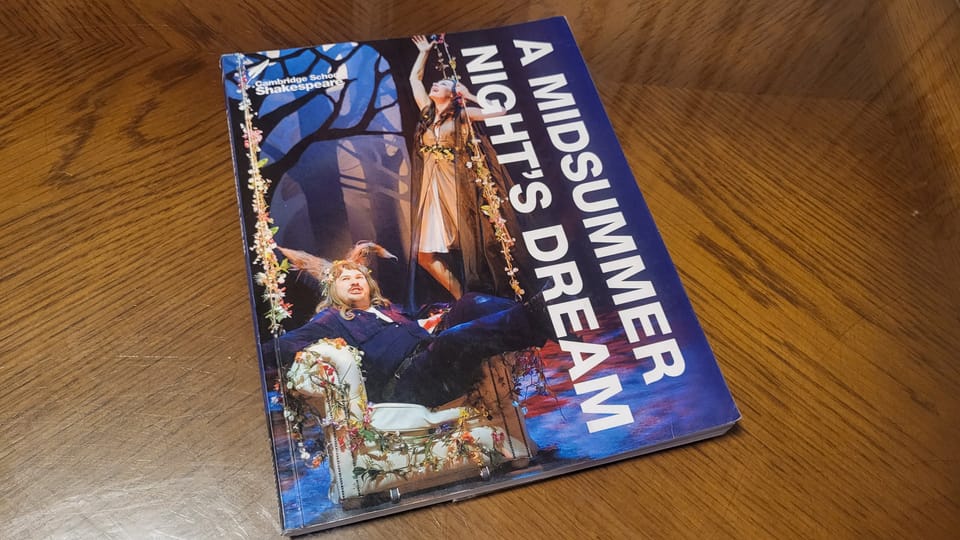
When I first watched A Midsummer Night’s Dream in my English room room, I recalled a time when I saw a play called Bottom’s Dream, a playful retelling of A Midsummer Night’s Dream.
I really enjoyed it, but watching the full play made me appreciate it more. As the screen darkened, I asked myself a question.
Are the things we see real, or do they only seem real?
The play sharpens this blurred line between appearance and reality, particularly when it ends at love.
A Midsummer Night’s Dream begins with four lovers: Hermia, Lysander, Helena, and Demetrius. Helena loves Demetrius, who loves Hermia, but Hermia loves Lysander. Hermia and Lysander run away into the forest, pursued by Demetrius and Helena.
In the forest, the lovers argue. The fairy king, Oberon, watches on and orders his servant, Puck, to ease their relationships with a love potion — causing chaos.
Demetrius and Lysander compete for Helena’s attention. Helena believes the men are mocking her. Hermia feels betrayed when she ‘sees’ Helena has ‘stolen’ Lysander.
From this, we can learn that love isn’t simply bliss. Instead, love is a range of different emotions, from jealousy and rivalry to confusion and anger. Even this isn’t fixed, as love fluxes.
However, love can easily be shaped by perception rather than genuine connection. This is evident through Puck’s love potion, which makes the victim fall in ‘love’ with the first creature they see. It’s supported in Act 1 Scene 1 through Helena. “Love looks not with the eyes, but with the mind.”
Meanwhile, deep inside the forest, Oberon and Titania, the fairy queen, appear powerful and harmonious. Beneath lies manipulation. Oberon wishes to employ a changeling boy from Titania, who refuses.
From this, we can deduce his love for Titania is more or less fake. It exists only so long as it benefits himself. This idea can be seen today, especially in the way people build relationships. Genuine relationships mean real feelings, not manipulation.
Shakespeare explores the general idea not only in the lovers’ relationships, but also in the play within the play Pyramus and Thisbe, a parody of Romeo and Juliet. The Mechanicals perform exaggerated versions of love, reminding us how life can feel like a performance. People often present a different version of themselves depending on who is watching — just as actors do on stage. I’m nice to my parents whenever I want something.
This is also seen throughout A Midsummer Night’s Dream. The protagonists begin to question what is real and what is a ‘dream’. Bottom sums up his own ‘dream’: “I had a most rare vision” (Act 4 Scene 1). In the play (and real life), theatre acts as a device that unsettles our sense of reality.
As the lovers retire to bed after their wedding, Shakespeare tells us that what we see is not always the truth. A Midsummer Night’s Dream tells us how perceptions can mislead us, while we take what we see for granted in relationships.
Perhaps that is Shakespeare’s real message to us. What we see and what is real are not always the same.
Puck himself hints at this uncertainty in Act 5 Scene 1:
‘If we shadows have offended,
Think but this, and all is mended,
That you have but slumber’d here
While these visions did appear.’




Member discussion