Forgotten, but not Forgotten.
Author's Notes
This writing is a complete revision of a previous writing which goes by the same name. I used this writing as my very first entry to the Australian National History Challenge Competition 2025. Even if I don't win the competition, I am proud of how I learnt so many new things, such as how to research through various sources and summarising them into an annotated bibliography. I hope you enjoy this writing as much as I did.
Description
My historical fiction acknowledges both the fallen and those who endured the aftermath. Inspired by Hugo Throssell and grounded in archival research, it portrays hidden post-war struggles. I chose narrative writing to humanise history, not just to know, but to empathise with it.
Forgotten, but not Forgotten.
Throughout the streets, gas lights flickered, the dark fog of night barely disguising a hunched shadow dragging his leg along. Glaring women wielded their arms, their children huddling inside. “Come children! You’ll catch your death of cold!” The stump of his left leg and his eyepatch covering his right eye garnered attention, youngsters gathering round, hands cupped over their ears and mouths.
“I heard he fought in the war!”
Though the man wore his Victoria Cross, his limbs no longer belonged in society, his mind still wandering through the battlefield.
Inside a whispering enclosure of trees, two men lay huddled inside a dugout of a trench. One man, Josh, waved to another man, Hugo.
“Ever think about what you want to do after all this is over?” Josh nodded to his snow-jammed service revolver and his own Rising Sun badge. “I want to take up the old paintbrush. What ’bout you?”
Hugo smiled. "Dad thinks I should take over the family shoe shop, but I've got my sights set on writing. Who knows, maybe you'll end up doing the pictures for it!"
Josh laughed, mist escaping from his flaked lips. “There’s no way you’ll make any sales without my art! I mean—”
His sentence was cut short. Josh’s grin vanished as his hands covered his revolver, while Hugo withdrew his own from his holster. A low hiss filled the trenches, the greenish-yellow wind stinging their faces. Their peak caps sagged over their ears while their eyes widened with realisation.
As their fingers fumbled with the straps of their gas masks, a shrill noise burst in the distance, painting No Man’s Land in a red fire. Their eyes fell onto silhouettes of grey winter coats and stick grenades jutting from belts, eyes hidden behind the tinted yellow of their gas masks.
Ejected shells clattered before their boots as Hugo and Josh snapped six round speedloaders into their revolvers, hands slipping with frost and mud. Above them, the sky whistled. “Get down!”
Hugo threw himself into the snow. Yet, Josh fell too late.
With a tink, a thick red fog burst from the back of his head accompanied by a shard of metal. “No!” Hugo tugged at his friend, wiping his face with his sleeve. “Josh! Get up!” He tousled Josh’s bloodied uniform. All their campaigns, the stories they made and memories of laughing at home and in the frontlines lay covered in a blanket of snow. A bang and Hugo’s visions snapped to black.
A train screeched against its own metalwork, as Hugo’s eyes shot open. The sound split Hugo’s ears, as his hands flew up to cover them, his nerves twitching. Posters labelled “REPATRIATION: HELP THE MAN WITH THE MEDAL” hung on every corner of the street. It had only been days since the Armistice had been signed. Hugo could still hear the buzzing of the city square: people waving Australian flags and hats flying in the air. Yet, the jubilation did not linger.
Even in the trenches, Hugo scribbled stories onto ration paper, tucking them close to his chest. Now, back in the city, he carried those same pages to a magazine office. Stepping inside, he laid a small package with paper protruding on the counter, his fingers lingering. The man behind the desk flicked a quick glance at the crooked sleeve of Hugo’s coat, sliding the manuscript inside a pile of unopened works. Hugo turned to leave, swallowed by the clatter of typewriters.
Hugo stepped back onto the street. His mind flashed to the unopened bills stuffed into a drawer, and his hollow coal bin. His gaze clung to the window of a bakery, stomach tightening at the scent of bread. In the shadow of the Great Depression, Australia’s government had little left to offer men like him.
Hugo looked at a “HELP WANTED” sign hanging from a shoe store. He entered the shop, lips parted. The shopkeeper looked up at the stump of Hugo’s leg, his arms stuttering, before handling already-neat rows of shoe polish behind his desk. The bell above the door chimed, and a line of men in pressed suits filed in. The shopkeeper’s face lit up, his voice warm with welcome: “Gentlemen! Right this way.” They laughed, their shoes clicking across the tiles.
As Hugo turned around, he stopped at a sign for a pawnshop as he looked down at his own medal. The pawnbroker’s eyes, inside the shop, glinted towards the medal. “Hey! That’s a pretty medal! I’ll take it for ten shillings.”
Hugo walked past towards his house, his hands clutched the medal tighter than ever before.
Stepping inside the dim comfort of his house, Hugo’s fingers unfurled an envelope on the table, as his eyes skipped through the letter.
We acknowledge receipt of your application for increased medical pension. In the wake of the postwar recession and limited government funding, we are unable to follow your request. We regret the delay and assure you your file remains on record.
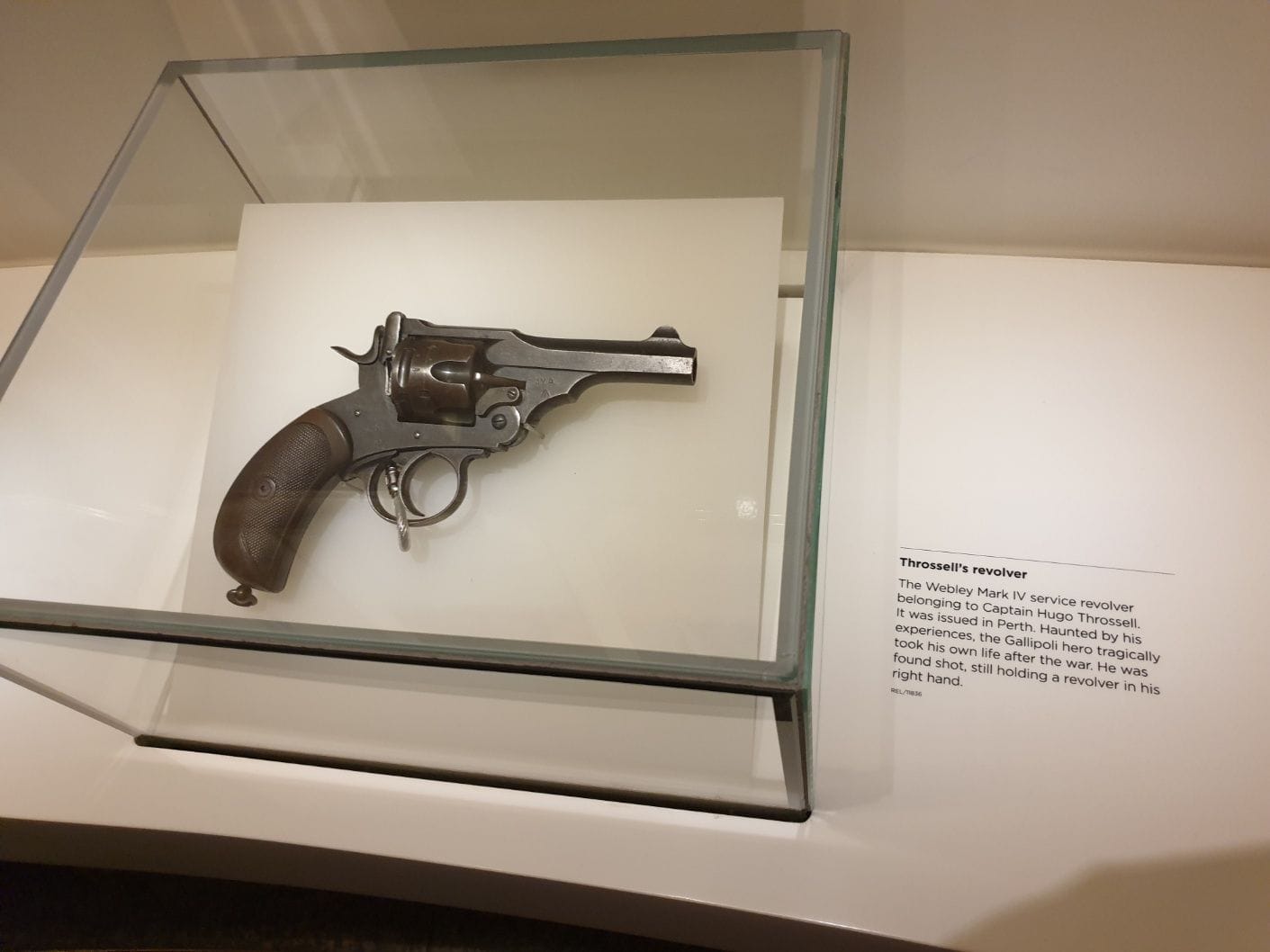
With every moment, the ghost of a scream flickered. Hugo’s hands dropped the letter, sinking onto his knees. His eyes caught a glint of brown and silver mounted on a drawer: a memento of his officer service. It was his service revolver.
Hugo, with red-rimmed eyes, stared at the revolver. His Adam’s Apple bobbed up and down, his breath trembling. Hugo’s eyes rolled over the last picture he had taken with Josh. They were smiling, arm around arm, the morning light embracing their faces. A thin shimmer clung to his lashes, refusing to fall.
A flash of yellow erupted across the room.
His death was nothing to the world, and the world to him was no more.
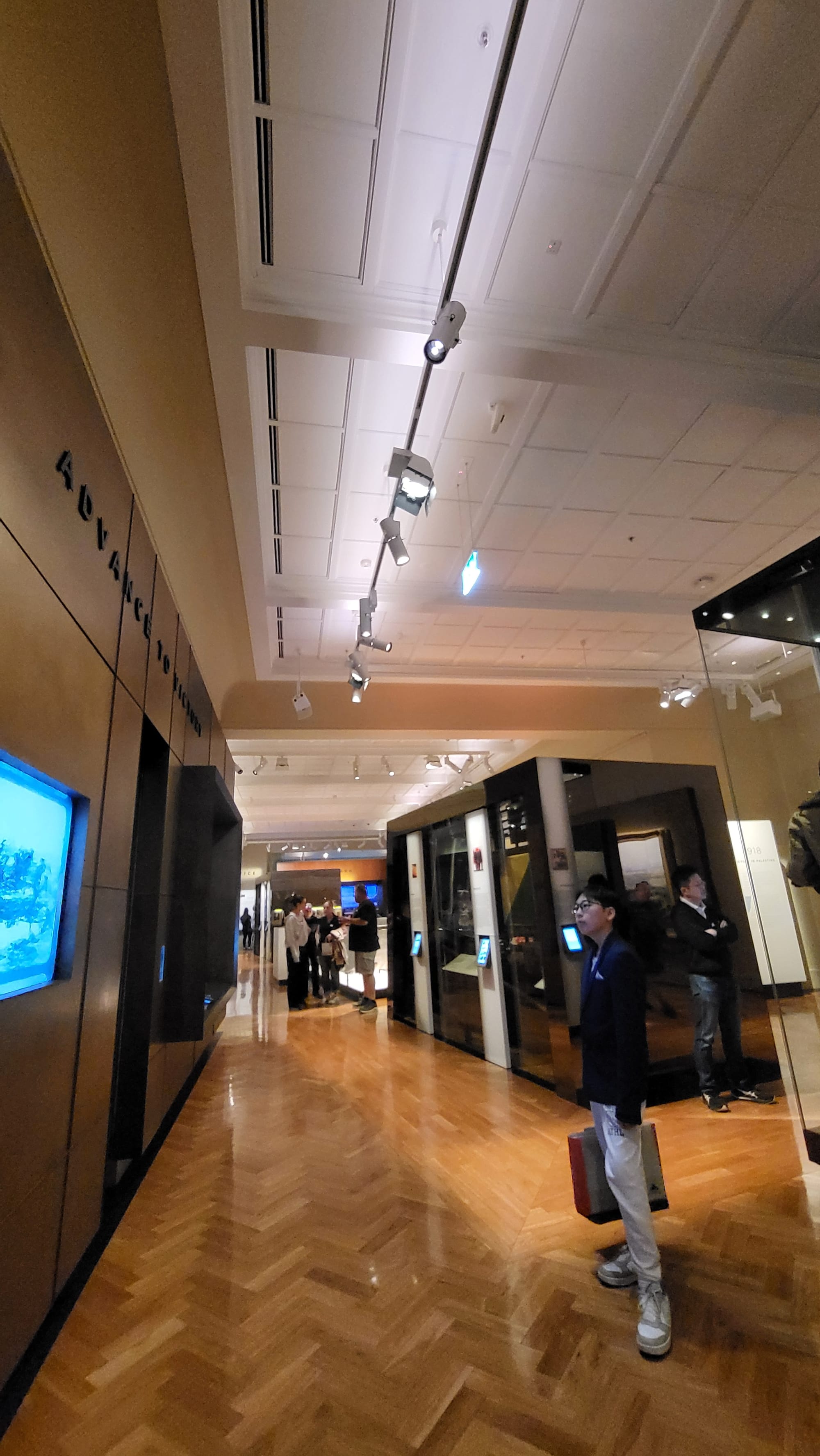
A century later, in the white corridors of the Australian War Memorial, I stopped at a photograph of a soldier with dark glasses and an empty sleeve. This was a reminder of veterans’ hidden wounds Australia only later recognised. Edward Millen’s repatriation acts and the War Memorial could never restore what was lost in the trenches. Yet they marked the first attempt at resolution: to acknowledge sacrifice and to promise remembrance.
But resolutions are not only written in parliaments and monuments. Even a single life can tell history, the suffering never truly resolved. Through my writing, I try to give back what war and silence once stole. When stories are written, read, and reinterpreted, those once forgotten rise and breathe anew.
Conflict is never fully resolved, but in remembrance, society learns, reforms, and vows.
That is why I write, so they may always be remembered.
Forgotten, but not forgotten.
Annotated Bibliography
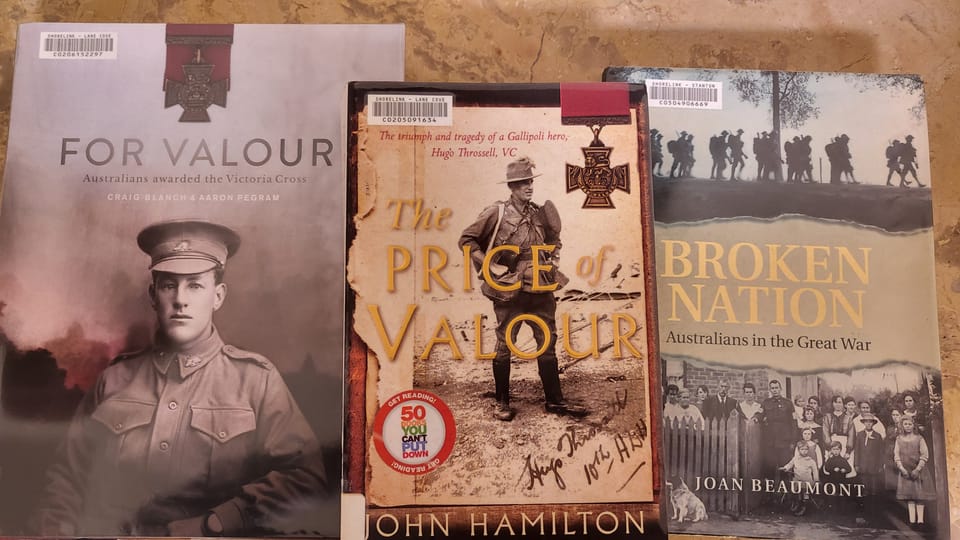
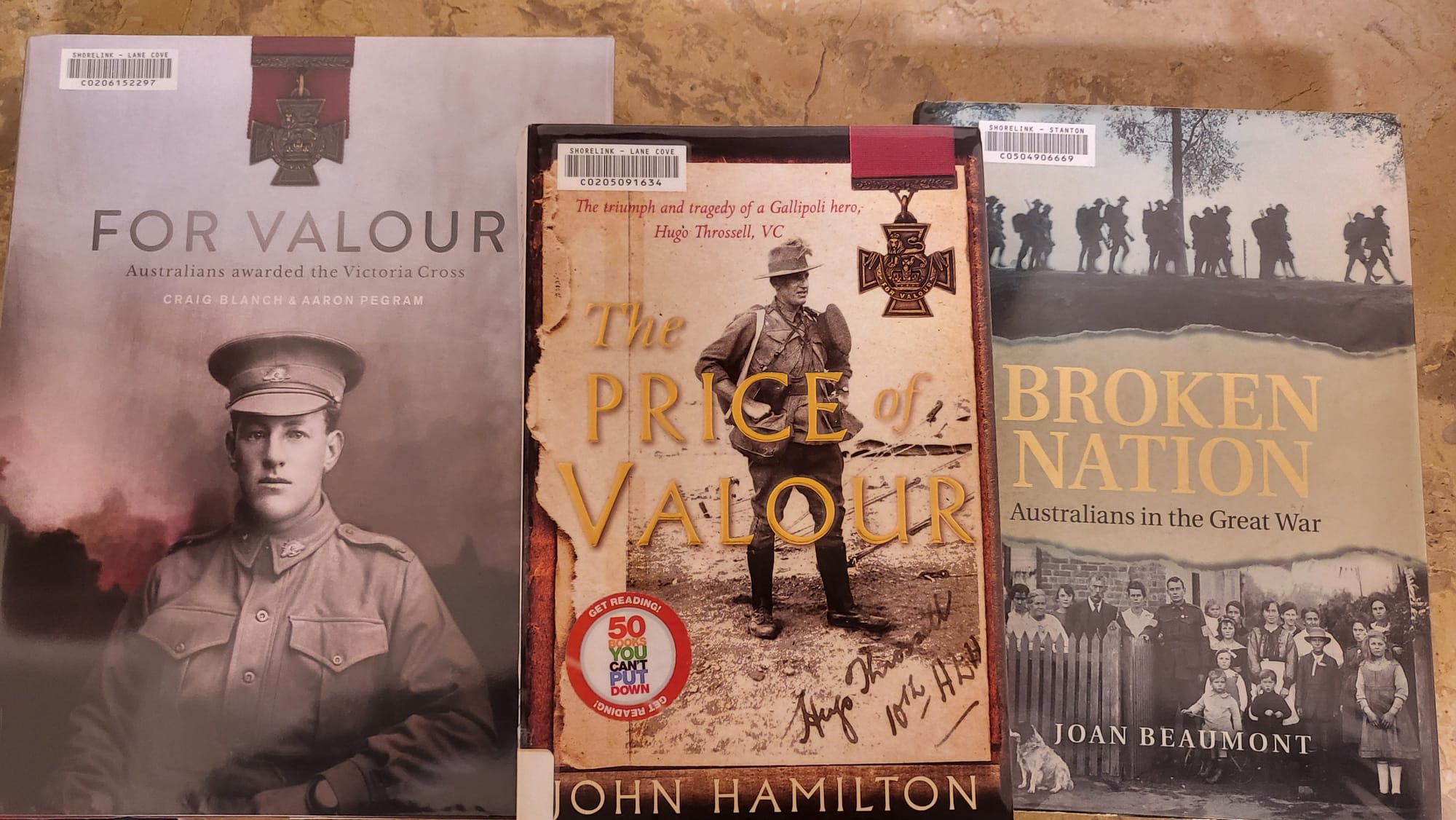
1. Hamilton, John. The Price of Valour. Pan Macmillan Australia, 2012. (Secondary Source)This biography of Hugo Throssell VC provided crucial insight into his postwar trauma and eventual suicide. I learned how deeply Throssell was scarred by his wartime memories. Due to his severe financial debts, he was offered to pawn his Victoria Cross for only ten shillings - an act that resonates with the book’s title. I was inspired by this to depict society’s cold response to a veteran. It also shaped my portrayal of Hugo’s final, tragic moments. The Price of Valour also reveals how Hugo wanted to reveal his war experiences and thoughts through writing, but was mostly rejected, just like the protagonist in my story.
2. McLachlan, Matt. Living History Podcast (2022–2025). (Secondary Source)In the episode Australia After WWI, featuring Professor Joan Beaumont of the Australian National University, I gained expert insight into the Depression’s impact on postwar society. I learned that returned soldiers were among the most vulnerable, as the government lacked the resources to adequately support them during the financial crisis. It informed my portrayal of Hugo’s inability to “retrofit” into civilian society, showing that structured reforms still left returned soldiers in limbo, caught between national pride and institutional neglect. These accounts inspired me to situate my protagonist in the harsh aftermath of the Great Depression.
3. Throssell, Catherine. Letter to the Repatriation Commission, c.1934. National Archives of Australia. (Primary Source) Accessed August 10, 2025In this moving appeal, Catherine Throssell brings up the lack of medical help displayed towards her husband’s insomnia, depression, and war injuries before his suicide. Her words gave me an intimate window into the daily anguish behind the image of a “war hero.” This letter was central to shaping Hugo’s collapse - not as an abstract case of shell shock, but as nights without sleep, mounting debts, and the slow erosion of dignity.
Books
4. Beaumont, Joan. Broken Nation: Australians in the Great War. Allen & Unwin, 2013. (Secondary Source)
5. Pegram, Aaron. For Valour: Australians Awarded the Victoria Cross. NewSouth Publishing, 2019. (Secondary Source)
6. Wartime Magazine. Australian War Memorial, Issues 11, 2000. (Secondary Source)
Visits
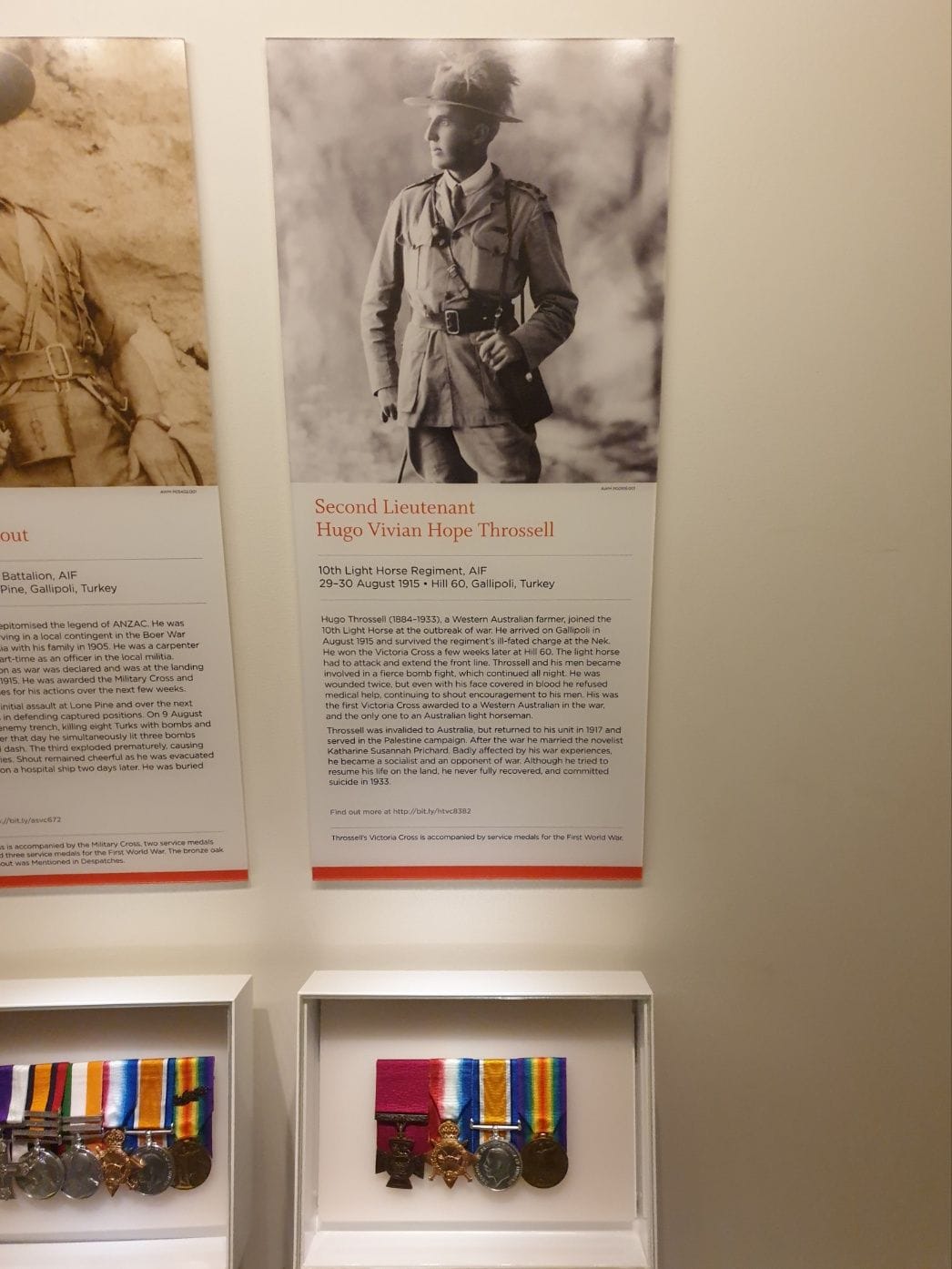
7. Australian War Memorial (AWM), Canberra. Multiple visits (2021–2025). (Primary Source)
8. Australian Museum, Sydney. Multiple visits, Level 2, Influential Australians (2021–2025). (Primary Source)
Websites & Archival Sources
9. “Repatriation Problem(s).” The Sun (Sydney), 1920–1921. Retrieved from Trove. (Primary Source) Accessed August 9, 2025
https://trove.nla.gov.au/newspaper/article/113610625
10. “The Frightful Repatriation Muddle.” The Register (Adelaide), 1921. Retrieved from Trove. (Primary Source) Accessed July 14, 2025 https://trove.nla.gov.au/newspaper/article/145773753
11. National Archives of Australia (NAA). “Hugo Throssell’s Will and Suicide Note,” 1934. (Primary Source) Accessed August 16, 2025
12. Anzac Portal. “Weapons Used by the Australian Army in WWI.” (Secondary Source) Accessed July 29, 2025 https://ansacportal.dva.gov.au/wars-and-missions/ww1/military-organisation/army-weapons
13. NAA. “Treatment of Returned Soldier Suffering Shell Shock.” (Primary Source) Accessed July 16, 2025 https://www.naa.gov.au/students-and-teachers/student-research-portal/learning-resource-themes/war/world-war-i/treatment-returned-soldier-suffering-shell-shock
14. DVA. Repat – A Concise History of Repatriation in Australia. (Secondary Source) Accessed August 8, 2025 https://www.dva.gov.au/documents-and-publications/repat-concise-history-repatriation-australia
15. Sir John Monash Centre (SJMC). “Homecoming After the War.” (Secondary Source) Accessed July 29, 2025 https://sjmc.gov.au/homecoming-after-the-war/
16. Federal Register of Legislation. Australian Soldiers’ Repatriation Act 1920. (Primary Source) Accessed July 10, 2025 https://www.legislation.gov.au/C1920A00006/asmade/text
17. “The Old Soldier Pawns His Medals.” Trove. (Primary Source) Accessed August 4, 2025
https://trove.nla.gov.au/newspaper/article/78811984
18. “Why Did Officers Carry Pistols & Not Rifles into battle?” War History Online. (Secondary Source) Accessed August 16, 2025
https://www.warhistoryonline.com/instant-articles/officers-carry-pistols-not-rifles.html
Pictures & Images
19. Armistice Day, Sydney, 1918. Australian War Memorial. (Primary Source) Accessed August 3rd, 2025
https://www.awm.gov.au/collection/C281780
Member discussion