Michaela's Story
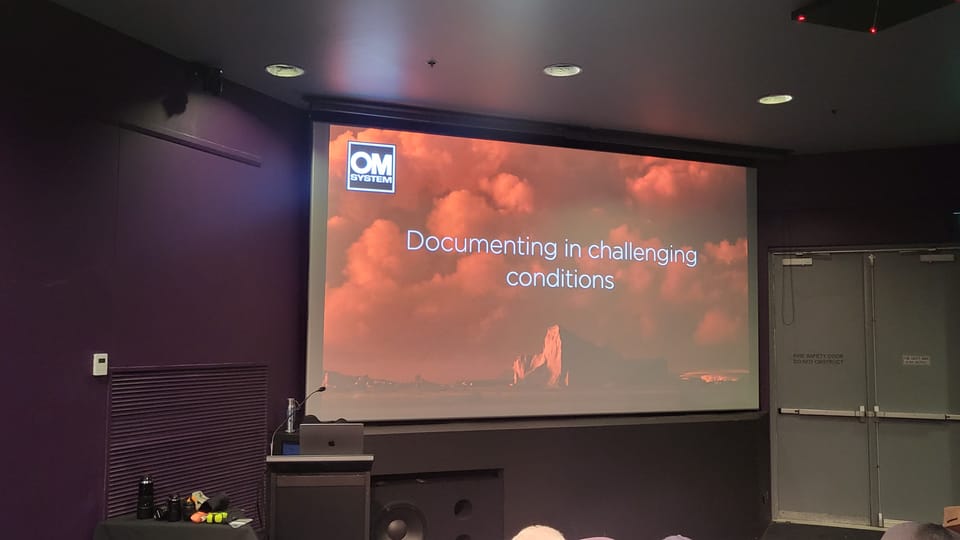

As we entered the Maritime Museum, the glass of passing buildings reflected us. I had often visited the museum to see exhibitions, like James Cameron's explorations. Yet today, my family and I entered a theatre to listen to an underwater photographer, Michaela Skovranova. As the lights dimmed and we settled into velvet chairs, little did I know that her words would change the way I thought about both nature and storytelling.

Growing up in Slovakia, a landlocked country where the sea existed only in books and pictures, Skovranova moved to Australia at 13, where the ocean became not just a presence but almost a destiny. With no experience in photography, Skovranova began slowly, using film cameras that forced her to be patient and deliberate. Those early moments, combined with her curiosity about what lay beneath the surface, became the foundation of a career that would eventually take her to National Geographic, Greenpeace, and projects across the world.
As she spoke, I realised her story wasn’t about camera gear or technical skill - it was about the lessons she had drawn from nature itself. She described challenges that might have defeated others: fogged vision in Antarctic waters, hurricane-force winds at sea, dives that left her drained. But she didn’t frame these as failures. Instead, they became thresholds, moments that opened onto unexpected beauty, like a vermillion sunset after a long, disappointing day. For Michaela, resilience was not about conquering nature, but about accepting it - shifting perspective, and finding meaning in whatever emerged.
Her philosophy also reshaped what it meant to be present. She recalled one evening sitting quietly as a turtle laid her eggs, waiting until the moment had passed before switching on her red light. Even if she had captured nothing, she said, the act of being there was enough. Photography was not only about making striking images but about bearing witness, ensuring that fragile ecosystems and fleeting moments were not forgotten. Sometimes, she even takes “photos with her eyes,” practicing the discipline of slowing down and truly seeing.
One part of her talk intrigued me most: her rejection of the myth of the solitary artist. Michaela explained that her work is always collaborative - built on research, tide charts, carefully planned budgets, and, above all, trust in local guides who know the animals and the terrain better than anyone else. Collaboration isn’t just theoretical. It acknowledges that stories are never inspired by one person alone, but always in harmony with community and place.
Perhaps her most powerful insight was about patience. As my brothers began wobbling their chairs, nature, she reminded us, cannot be rushed. Whales breach when they wish, corals may spawn one night and not the next, and sometimes strong currents end a dive before it begins. Sometimes the photograph comes, sometimes it doesn’t. What matters most is showing up, waiting, and learning to respect the rhythm of the environment. In this patience lies the truest kind of storytelling - the kind that cannot be forced, but that reveals itself when we are quiet enough to listen.
As the talk came to a close and I stepped out of the room, Skovranova’s words echoed inside my mind. Nature is unpredictable and uncontrollable, yet it is rich with meaning if we choose to meet it with humility. As I left the museum that afternoon, I carried with me a lesson that stretched far beyond photography: that in life, as in art, the truth is discovered. It is found in waiting, in resilience, and in the courage to see beauty even in uncertainty.



Member discussion