Review: Eddie Jaku's The Happiest Man on Earth
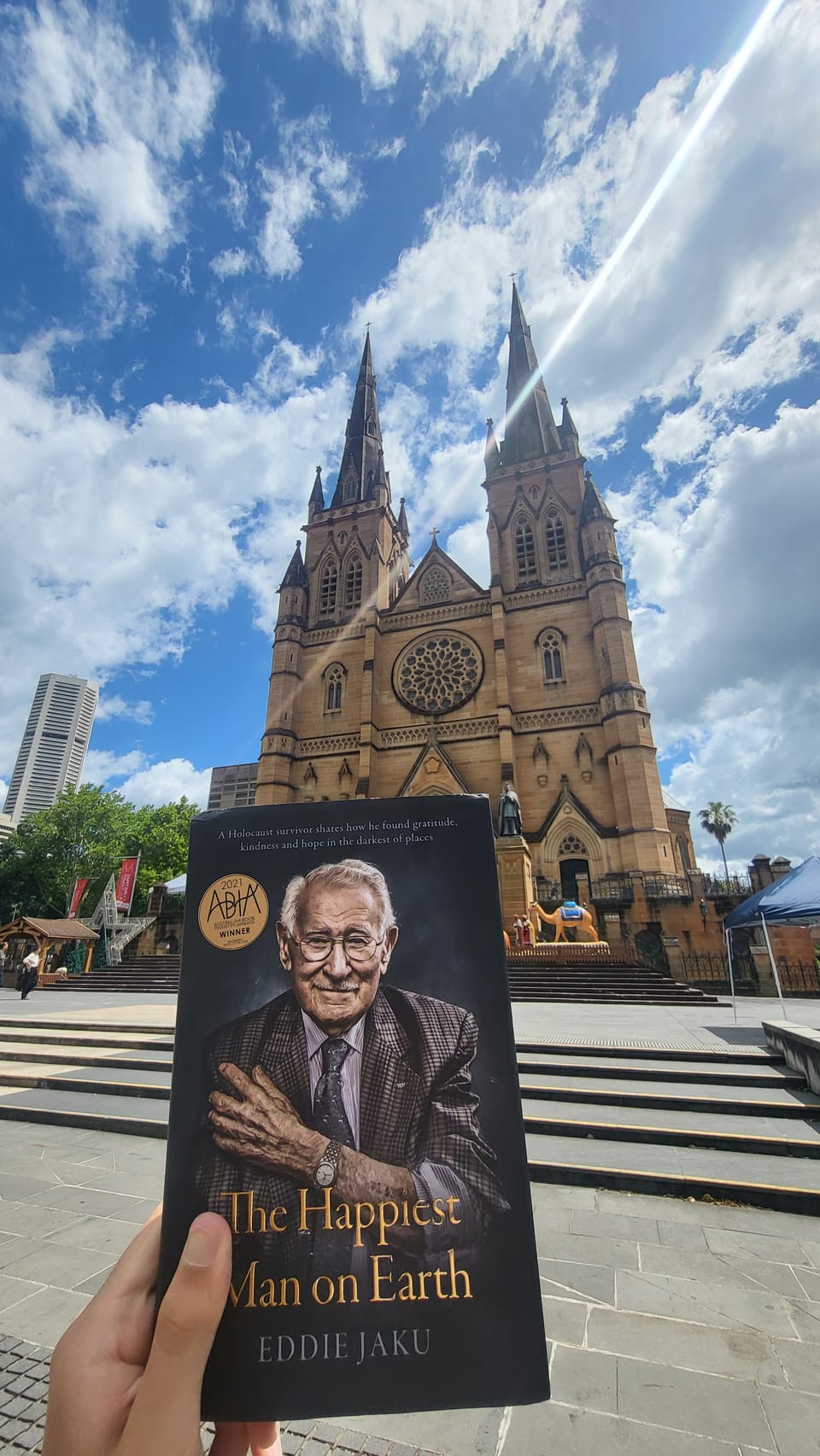
I had an experience when I failed to decipher Victor Frankl’s Man’s Search for Meaning. Recently, my mother was reading the book, The Happiest Man on Earth. She came forward. “Frankl’s book is too hard for you, so how about this?” And so, Eddie Jaku’s The Happiest Man on Earth was added to my collection of favourite books.
The title cover revealed nothing about the horrors hidden in extraordinary detail within its pages. That is, until one’s eyes come across the folded sleeves of Jaku’s left arm. A permanent token of the past: his prisoner number from Auschwitz, A-7713. How can a man who has lost everything - his family, his possessions, and his humanity - call himself ‘the happiest man on Earth’?
Eddie Jaku and his family considered themselves German first, German second, and then Jewish third. Jaku considered himself to be raised in the most civilised of societies: how wrong this statement was. With the introduction of the Nazi Party and World War II, everything was stripped and taken away from him. His parents and pet were murdered, his possessions stolen, his life humiliated.
In spite of everything, Jaku never surrendered to despair. Even after the Nazis had shattered his world and taken nearly everything from him, he refused to let hatred take root in his heart. Instead, he made a deliberate choice each day to remain happy. He often said that people act out of fear, and that fear can twist judgement until the ‘right’ decision feels impossible. By seeing others - even his oppressors - through this lens of fear rather than malice, Jaku protected his own spirit. It was this understanding, this compassion in the face of unimaginable cruelty, that allowed him to hold on to happiness when it should have been out of reach.
In The Happiest Man on Earth, Eddie Jaku reframes happiness not as a feeling but as a deliberate act of defiance. His insistence that ‘happiness is a choice’ gains extraordinary weight precisely because it emerges from the infamous Auschwitz and Buchenwald, the Death March and the annihilation of his family - places where hope should have been impossible. For Jaku, rejecting hatred is not naïve optimism but a conscious refusal to let his captors shape the rest of his life. Locations such as Auschwitz were designed to instil fear, hate, and despair in their prisoners. In this way, happiness becomes resistance - a way to reclaim dignity and declare that cruelty will not have the final word.
Friendship in Jaku’s memoir is not just comforting - it is life-saving. Throughout his ordeal, Eddie survived because of the unwavering loyalty of his Jewish best friend, Kurt, whose presence becomes a quiet promise that goodness still exists even in a world built to destroy it. When Eddie is injured, it is Kurt who comes to his aid, even bringing his own dinner for Eddie in his hospital. Their companionship offers warmth in places designed for cruelty, reminding Eddie that hope can be carried by another person when one can no longer hold it alone.
Acts of friendship also appear in small, unexpected ways - former family friends who help him, fellow prisoners who share their limited food, or even brief moments of humanity from strangers. An SS guard helps Jaku escape, while the commander of a concentration camp orders Jaku to be fed extra food. These connections form a fragile but persistent thread of kindness. They anchor Eddie’s belief in life and show him that even in darkness, friendship can still create silver linings.
Even after witnessing humanity at its worst, Eddie Jaku chose to believe in its possibility for good, rebuilding his life brick by brick on the foundations of kindness, hope and friendship. His legacy urges us to consider what we cling to when life grows cruel, and whether we, too, might choose hope when despair comes calling. The real question is not whether Eddie Jaku was the happiest man on Earth, but whether we are brave enough to seek happiness with the same ferocity.
As Jaku put it, “Life can be beautiful if you make it beautiful. It is up to you.”
Member discussion