Review: James Cameron’s Avatar series
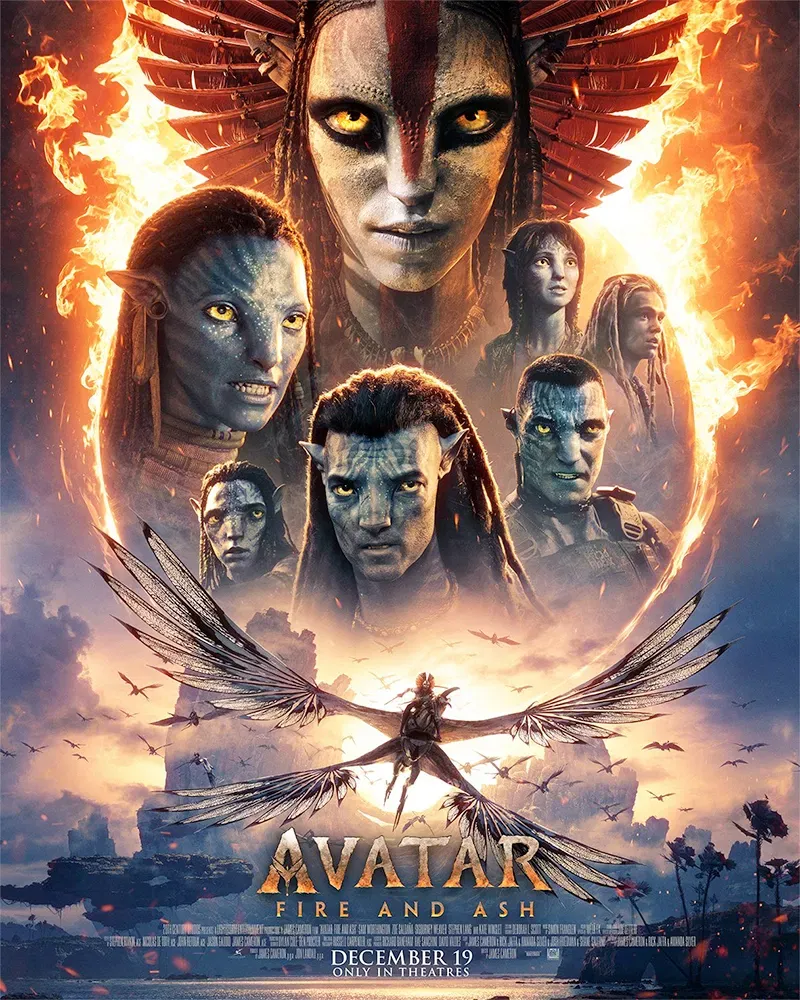
For my family, going to the cinemas is a rare treat. My own ‘Lil’ Devil’ of a brother breaks the movie’s flow by constantly activating the high buzzing of the recliner. Besides, what’s the point of going to the cinemas when we have a TV? Yet surprisingly, James Cameron’s Avatar series is such that my brother sits with twinkling eyes, watching the screen.
When I first watched the films, I enjoyed them so much that I ended up rewatching the series over twenty times.

In Cameron’s vision of the future, we are presented with a world where environmental collapse pushes humans to seek survival elsewhere. As a result, the Resources Development Administration (RDA) mines unobtanium on Pandora. This is supported by avatars—bodies that blur the line between humans and Na’vi, natives to Pandora.
What struck me most was how Avatar overlaps with realities still unfolding today. The film tells us that a “Resource Wars” was fought. The Resource Wars in Avatar are not imaginary. Rather, they echo what still happens in the real world today.
Sully went to Venezuela as a Marine to secure resources. Intriguingly, this evoked recent power struggles fought over for materials as well, particularly Venezuela and the United States. That connection brought to mind something my mother once taught me about investing in robotic stocks. Robots—and modern weapons—depend on rare earth elements. Even the most futuristic technology is bound to an old struggle: who controls the supply chain.
In the end, whoever controls the raw materials controls the world. This is further reinforced by the actions taken by the humans to harvest minerals. The administration bulldozes entire forests, creating violent kaleidoscopes of red, engulfing wildlife. Likewise, Na’vi spiritual locations are replaced with mining and militaristic buildings. In one clip, the RDA destroys the Omatikaya’s sacred Hometree to mine more unobtanium. This reminded me of how the heritage of Australia’s First Nations people was defaced under British colonisation.
I felt uncomfortable, almost guilty, as if I was watching a documentary of the past rather than science fiction. That feeling deepened when I noticed the window echoing the American flag in the mess hall, reflecting on America’s colonial history.
Yet Avatar doesn’t stop at human flaws. It also questions our identity and allegiance. The conflict comes into focus through Jake Sully, a paraplegic former Marine sent to infiltrate the local Na’vi Omatikaya for restored mobility.
However, by exploring Pandora through his avatar’s eyes, Sully falls in love with the forest and the Na’vi people. This quickly poses a problem. The more he reports back to his superiors, the more he falls in love with Pandora. His mission forces a choice: either remain loyal to the RDA and humanity, or the Na’vi and Pandora. Until then, Sully had been little more than an expendable soldier, obeying orders without question. He chooses morality over obedience.
Identity is revisited through Colonel Miles Quaritch, the antagonist in Avatar. Much to my surprise, he is resurrected as Recom Quaritch—an avatar carrying the memories of his deceased human counterpart.
In a scene reminiscent of Hamlet, Recom Quaritch confronts the remains of his former self. By crushing his skull, he declares his own independence. Quaritch is reborn stronger than the humans as a new villain, pursuing complete power.
As the Avatar series progresses, another theme I kept mentally in my drawer was family bonds and connection. Sully and his wife, Neytiri, are but parents trying to protect their children while navigating the pressures of war, tradition, and belonging. Meanwhile, the children never hesitate to help each other out of tight situations. It’s an admirable quality I wish my brothers and I had more of, though perhaps we will someday. Across the films so far, family is portrayed as a network of loyalty, responsibility, and love, giving strength and purpose (and, from my perspective, a family to look up to).
James Cameron’s Avatar films frame the future and the present as a moral reckoning rather than a technological triumph. That’s why Avatar is an exception for me. Beneath the endless droning of my brother’s recliner, the film still asks the question that matters most: who are we becoming?





Member discussion