Review: “Surely You’re Joking, Mr Feynman!”
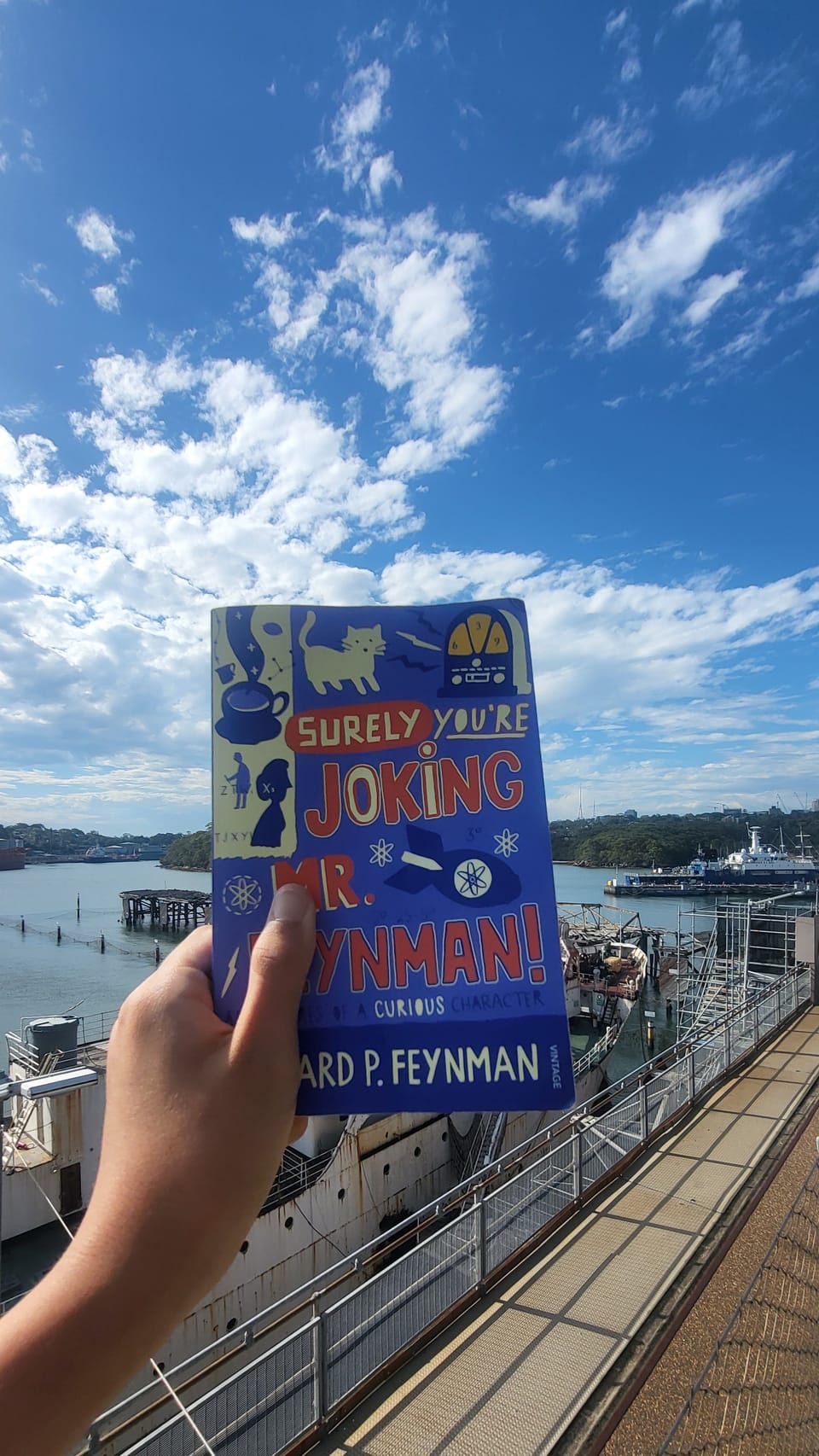
In my life, science books were a thing of wonder: they would be praised by everyone, yet whenever I put myself to read one, I would end up closing the book without reading the first chapter. For three years, “Surely You’re Joking, Mr Feynman!” sat in a bookcase, its scientific words giving stress to my eyeballs. I came across the book again later on, when its cute cover, directly contrasting what I thought of a typical science book, appealed to me. I was drawn in: its scientific terms still bedazzled me, but it was enough for me to understand the meaning of the book.
“Surely You’re Joking, Mr Feynman!” was no ordinary science book. On the contrary, its priority wasn’t science at all. Beneath its sunny side and pages lay stories of determination, curiosity, and independence, something uncommon in today’s society.
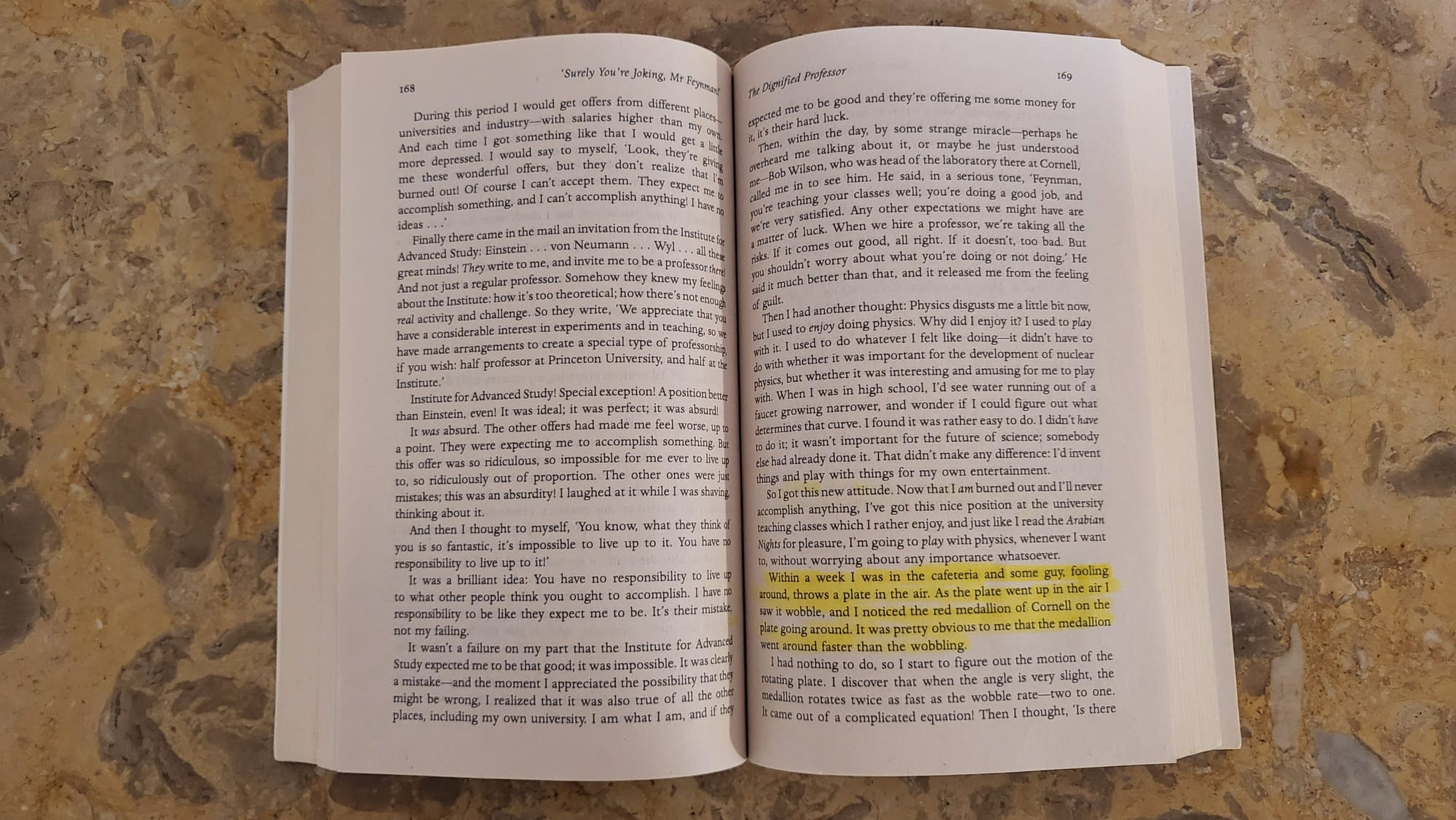
When Feynman was bored, he would sit, whether at home, work, or on leisure, and think. Feynman treats every unknown as a puzzle that demands a first-principles solution. This ‘undisciplined’ curiosity was where he followed his interests regardless of their apparent utility. In the cafeteria of Cornell University, a student threw a plate into the sky, the trademark Cornell crest spinning.
Feynman was fascinated by this sudden revolution, calculating the motion of the rotating plate. By playing with physics and throwing yet more plates, his curiosity spiralled into insights on quantum electrodynamics. It was this ‘discovery’ which earned him the coveted Nobel Prize for Physics.
Complemented with curiosity was Feynman’s determination. Whenever Feynman faced a problem, he almost always refused to let a problem remain unsolved. This trait is most evident in his ‘all-or-nothing’ approach to intellectual challenges, regardless of the field.
When Feynman was recruited to work for the government to create the first atom bomb, he had an idea. Feynman would walk around Los Alamos, attempting to pick open locks of the drawers of his fellow physicists. He practiced until he could feel the subtle ‘drop’ of the tumblers, eventually gaining access to high-level documents just to prove it could be done. After the war and in his later years, Feynman was diagnosed with cancer, yet he was admitted to a panel investigating the infamous Challenger Space Shuttle Disaster. It was Feynman’s determination which allowed him to deduce it was the faulty O-Rings which had led to the failure.
As I read “Surely You’re Joking, Mr Feynman!”, I noted Feynman’s independence and critical way of thinking. In the contemporary workplace, those lower than their superior’s status are afraid to criticise anything their supervisors do. They nod, agree, and occasionally say ‘yes, yes yes!’. This is especially relatable with me: at school, we never fail to repeat what our teachers say, even if their knowledge is flawed.
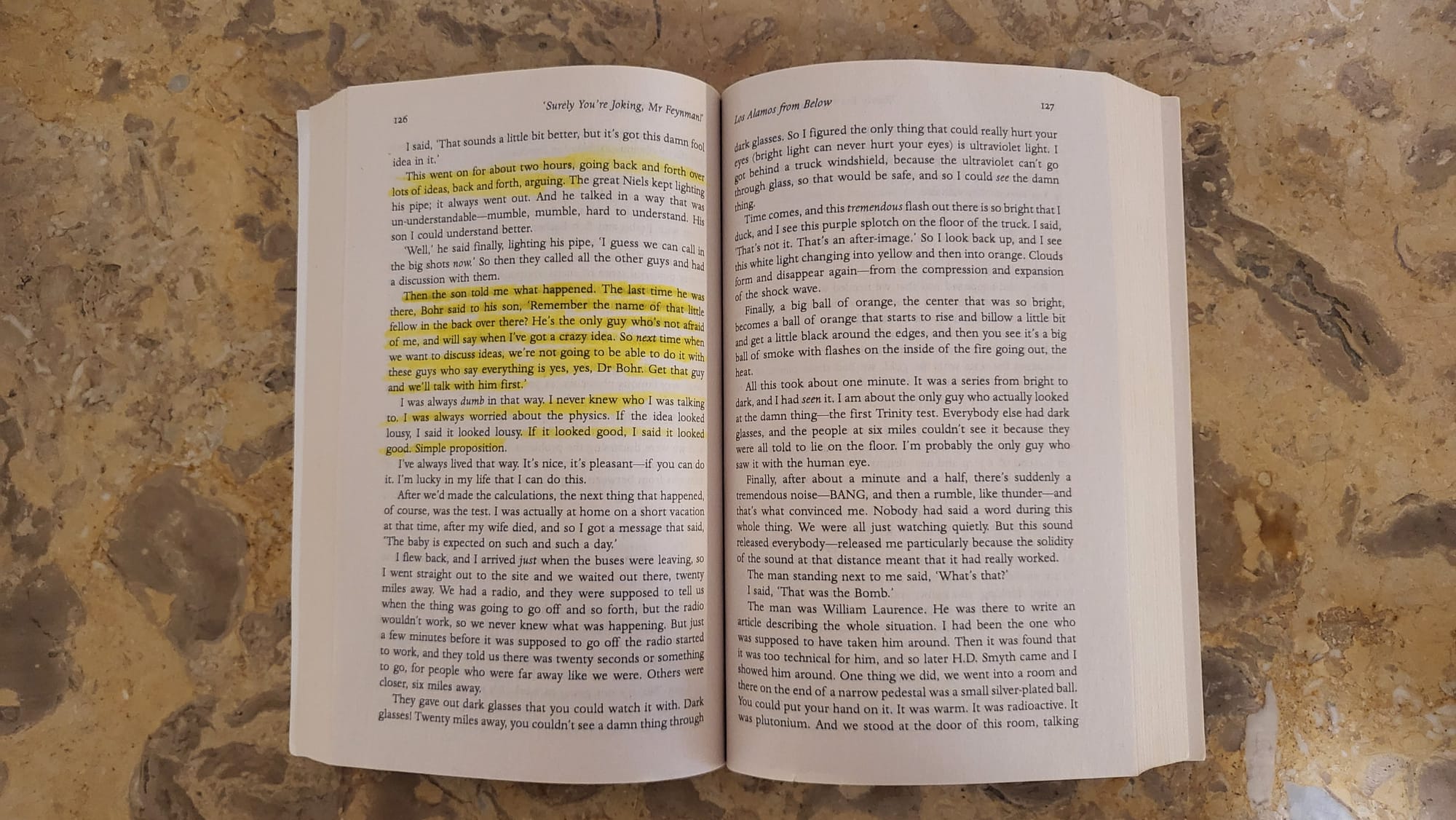
During his time in the Manhattan Project, whenever Feynman would convene with other scientists and physicists, he would listen to the ideas subjected before him, before openly speaking his opinion. Through this way, he criticises the ideas projected by those of Oppenheimer or Edward Teller. When he was confronted by Niels Bohr, the father of quantum physics, and his son, Feynman was praised for his ability to never hesitate to question authority, reminding me of Tom Sawyer, a quality instilled in him by his father.
Feynman had been universally trusted, albeit as a joker, in his time of office, from Los Alamos to his time in university as a professor. Yet, Feynman would only accept knowledge only when he would successfully verify the facts. When Feynman was sent to the Oak Ridge uranium enrichment plan, he was presented with blueprints of the site which had been assured by senior engineers “safe” and “all checked” in case of a catastrophic uranium breakdown.
While unsure of the nature of some markings (was this a window or a valve?), Feynman relentlessly chased the nature of the pipes and valves. He pointed to a marking closely resembling a window, and with some uncertainty blurted: “And what happens if that valve gets stuck?” The engineers looked up and down, side to side, and their eyes rested on each other. “You’re absolutely right, sir.”
“Surely You're Joking, Mr. Feynman!” revealed that the true essence of science - and of a life well-lived - is not found in the memorisation of complex terms, but in the relentless, joyful refusal to accept the world at face-up value. Feynman demonstrates that whether we are staring at a wobbling plate or a top-secret blueprint, we must strip away the ‘uniform’ of authority and trust what we can verify for ourselves.
He leaves us with a challenge that resonates far beyond the physics lab: to look at the world with our own eyes, ask the questions others fear to voice, and abide by the most dangerous rule of all. One must not fool themselves, as we ourselves are the easiest persons to fool.





Member discussion