"Good Afternoon, Good Evening, and Good Night!"
When your fingers untie the ribbons on the green-and-red wrapped present, your parents are there, snapping photos, etching your smiles into their holiday albums. But what if every moment of that joy was scripted?
This unsettling possibility sits at the heart of The Truman Show, where Truman Burbank lives a life that feels real — yet is entirely constructed for the entertainment of others.
Adopted as an infant and placed into ‘Seahaven’, the largest television set ever created, Truman grows up inside a carefully controlled world where every relationship and every moment is orchestrated by the show’s creator, Christof. Seahaven is not just a town — it is a stage, built entirely for an unseen audience.
At first, this feels almost absurd. After all, Truman’s world is built on scripts when ours isn’t. But the more I watched, the less certain that distinction became. Because while our lives may not be written line by line, they are shaped in quieter ways: not by scripts, but by systems.
In Truman’s world, that system has an architect — Christof. Christof sees the real world as it is: full of lies and pain. He defends the control by claiming Seahaven is the safest and most perfect place in the world. According to him, the illusion exists to protect Truman. Truman himself cannot choose his own path.
The more I thought about this, the more I felt uneasy. Christof had a point: is a painful truth more valuable than a perfectly controlled illusion of happiness?
Seahaven is not the only world built on this bargain. In The Giver, control is taken even further — pain is erased, memory suppressed, and emotion chemically neutralised, all in the name of creating a perfect society. A world which looks perfect, but feels hollow: just like Christof intended. Like Truman, the ‘perfect’ citizens in The Giver cannot suffer, but they also cannot choose; their view of reality is fragile.
Yet systems like these do not collapse all at once — they begin to crack.
Truman opens the door and walks onto the street, ready to repeat his daily routine for the ten-thousandth time. One day, a studio light suddenly falls from the sky, crashing onto the street beside him.
Initially, it’s these disruptions which challenge Truman’s unquestioned acceptance of his world. These disruptions include the unnatural repetition of background actors and even a radio frequency that begins to describe Truman’s every movement.
I was surprised to find that these details did not immediately alert Truman (interesting though, that Truman thought not much of the studio light nearly missing his own head). Instead, they plant small seeds of doubt, suggesting that systems of control do not rely on obvious barriers, but on something far more powerful: our tendency to trust what feels normal.
This is not a uniquely modern anxiety. Even in Shakespeare’s time, the same pattern of invisible influence took root. In A Midsummer Night’s Dream, lovers act on emotions conjured by magic; they never question their authenticity. The feeling is real; only its origin is false.
Both The Truman Show and A Midsummer Night’s Dream demonstrate that illusion is most powerful when it operates invisibly, embedding itself within emotion and routine. It is only when these illusions begin to crack that individuals are forced to confront the unsettling possibility that what they have always accepted as reality may, in fact, be constructed.
Towards the end of The Truman Show, Truman finally confronts the truth of his world. Despite the barriers imposed by Christof, such as fake bushfires, power plant failures, and unexpected storms, Truman pushes forward, continuing to search for what lies beyond the illusion. He continues to do this even when acknowledging he will not like what he will see.
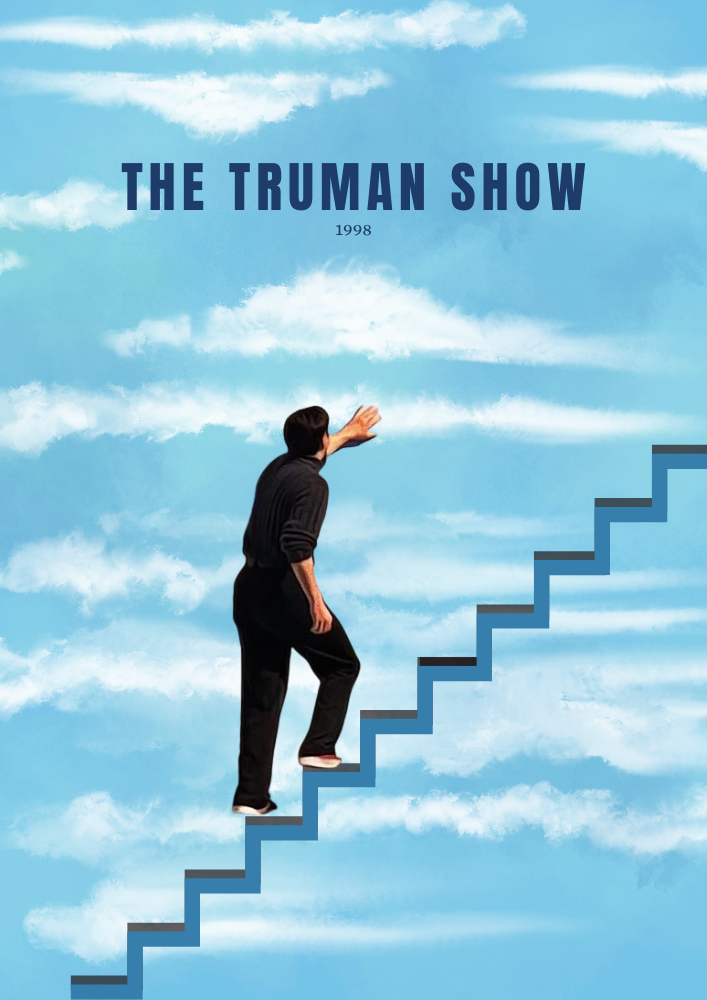
Truman’s journey is not simply physical, but psychological — a decision to value truth over comfort. When he sails into the unknown, overcoming his lifelong fear of the sea, it marks the moment he rejects the system that once defined his reality. As he climbs up the steps leading to an exit of the elaborate set, it’s Truman who opens that door, not Christof. In that moment, Truman reclaims the right to define his own reality.
Truman’s escape is more than a triumph over Christof’s artificial world — it is a reminder that truth, however imperfect, is inseparable from genuine freedom. His final choice exposes the quiet danger of systems that promise safety at the cost of autonomy, revealing that a life without uncertainty may also be a life without meaning.
By stepping through that exit, Truman holds the final word. While controlled happiness may feel safe, true freedom lies in the courage to reject illusion and embrace the uncertainty of reality.

Member discussion