Book Review: Stephen King's The Outsider
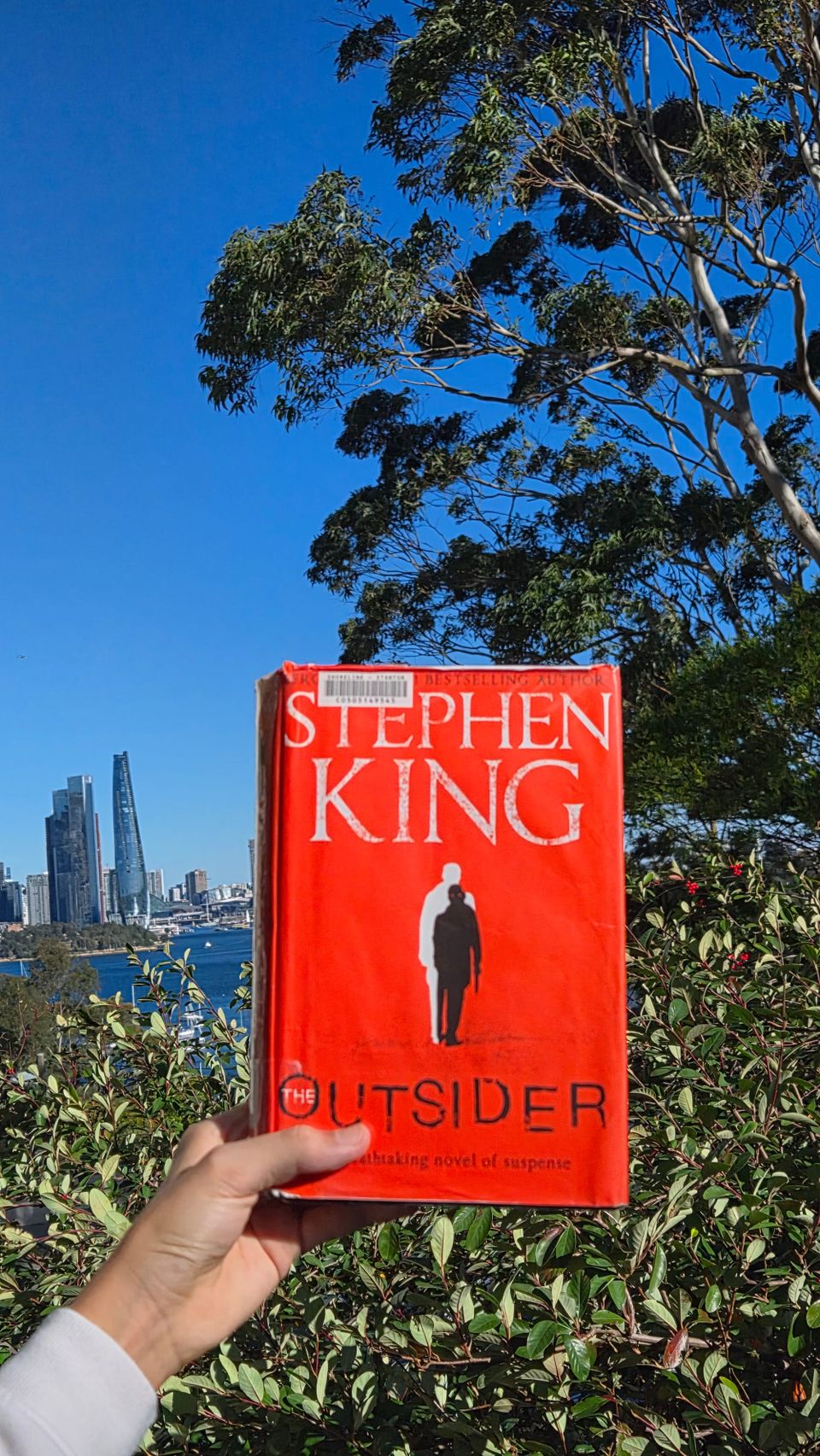
When I was at my local library, I was looking for a crime thriller. Crime thrillers always had two parts of the story which interested me: the cloak and daggers, and the gradual buildup to the point where the suspect is revealed. They always put me on the edge of my chair, and I would stay glued to the book even past bedtime.
Stephen King's The Outsider met my criteria. I had heard Stephen King countless times in the literary world. In fact, I had read some of his books in the past. I was quite lucky I had found the book. Before that, whenever I went to the library, his books were always on loan.
That said, I was definitely curious about King's crime thriller.

I put the book in my library bag, ironically printed with the quote, "Books are a portable magic.” - Stephen King.
I was not disappointed: every page I turned brought a new, fluttering sensation in my stomach.
When a boy is found murdered in Flint City, Detective Ralph Anderson arrests a well-liked baseball coach and family man named Terry Maitland. The case looks closed before it opens: Maitland's fingerprints are on the scene, his DNA is on the body, and multiple eyewitnesses place him there at the time of the murder.
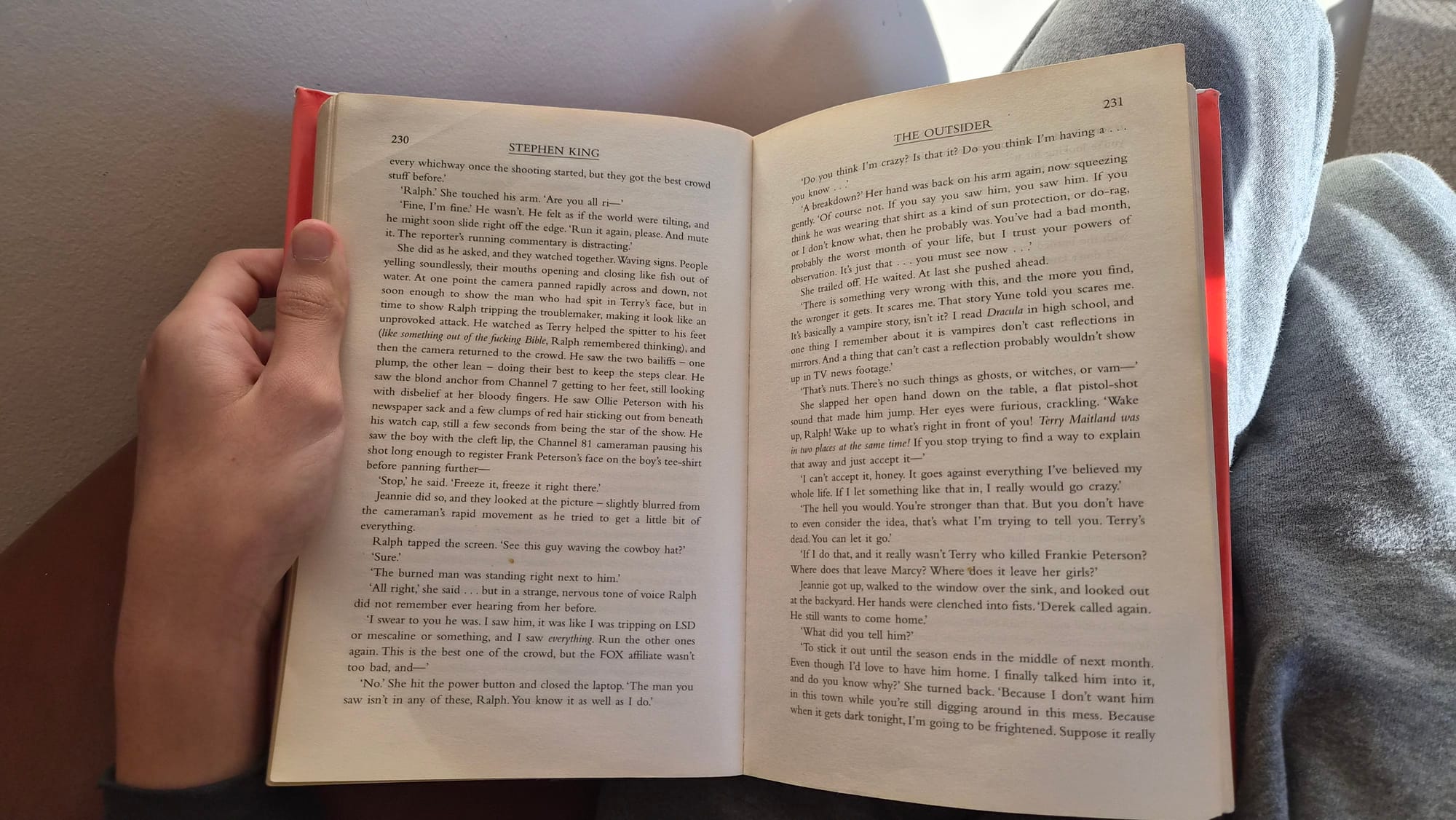
However, Maitland was allegedly three hundred miles away at a conference, caught on camera and seen by multiple witnesses. It's a simple fact: one man could not be at two places at once. King explores not who committed the murder, but what happens when the tools and certainty we use to know things turn out to be exactly the tools an unknown threat can exploit. The actual killer, it turns out, is a shapeshifting entity that survives by wearing other people's faces, feeding on grief, and letting our faith in what we can see do the rest of the work for it. How the Outsider survives is by relying on us to trust our eyes.
Reputation, when you strip it down, is just certainty wearing a name. We don't know people directly — we know what we've seen of them, what we've heard about them, what enough other people claim to have witnessed. When that perceived version is positive, we call it trust. When it turns negative, we call it judgment. Either way, it's built on the same material: sensory input, second-hand and incomplete, mistaken for the whole truth.
I watched this happen at school, on a much smaller scale than Maitland's case but with the same mechanism underneath it. When a student's personal life was leaked at my school the stories reached the school's group chat. Along the way, details had been added that were never true to begin with. Everyone believed they were just passing along what they'd heard — and believed it just as certainly as a witness believes what they saw. By the end of the day, people who had never spoken to this student had already decided, with total certainty, who they were.
Maitland's story runs on the same logic, just with far higher stakes. Before his arrest, he wasn't only a murder suspect — he was Flint City's Man of the Year, a coach whose team had made it to the state championship, a father people trusted with their own kids. That reputation had taken years to build. The arrest erased it in a single news cycle. And even after Maitland is proven innocent, nothing resets. His family is shunned. Friends quietly distance themselves. The damage was never really about guilt or innocence — it happened the moment the story took hold, long before anyone confirmed whether it was true.
Not so long ago, I watched a movie called The Shawshank Redemption. It tells a version of the same story: a banker is wrongly convicted of murder, and the accusation alone is enough to strip him of his old life permanently, regardless of what actually happened. Both stories agree on something uncomfortable — a reputation built over an entire lifetime can survive almost anything except one moment of being disbelieved.
King doesn't let this end quietly, either. Just after the boy is murdered, the boy's mother dies of a heart attack, his older brother dies after assassinating Maitland, and his father attempts suicide. This reminded me of the tragic ending scene of Hamlet, where everyone's lives were destroyed. The entity that started it all disappears by the final page, but it leaves nothing standing behind it. That's the detail that makes the book more than a monster story: the destruction doesn't require the monster to still be there. Once perception has done its damage, the damage runs on its own.
Certainty feels quite safe right up until it isn't, and by the time we're proven wrong, the people we were wrong about have already paid for it.





Member discussion